Implementing a secure ITAD lifecycle is the single most critical step your business can take to prevent decommissioned hardware from triggering a devastating data breach. Walk into almost any corporate office, navigate past the active workstations, and you will likely find it: the IT storage closet. It is the final resting place for out-of-warranty laptops, deprecated servers, broken tablets, and obsolete mobile devices.
For many organizations, stacking old hardware in a locked room feels like a temporary solution. In reality, it is a massive, compounding security vulnerability. Even devices that no longer turn on contain hard drives packed with sensitive intellectual property, saved employee credentials, and confidential client data. Leaving these assets unmanaged exposes your organization to data breaches, regulatory fines, and intellectual property theft.
Properly retiring hardware requires more than throwing it in a dumpster or handing it off to a local scrap collector. It requires a formalized IT Asset Disposition (ITAD) lifecycle. A secure ITAD process guarantees that your data is irreversibly destroyed, your hardware is responsibly recycled, and your organization maintains a legally defensible audit trail.
Here is the complete breakdown of the secure ITAD lifecycle, from the moment a device is retired to the final issuance of the Certificate of Destruction.
Stage 1: Inventory and Chain of Custody
The most critical vulnerability in hardware retirement occurs during transit. If a hard drive goes missing between your office and the destruction facility, your company must assume a data breach has occurred. The first stage of ITAD eliminates this risk through rigorous tracking and secure logistics.
- Asset Auditing Before any equipment leaves your facility, a comprehensive inventory must be established. This goes far beyond a simple headcount of laptops. A professional ITAD provider will log the make, model, and serial number of every individual data-bearing device. If a single laptop contains two hard drives, both drives are individually serialized and tracked. This inventory forms the baseline against which the final audit will be measured.
- Secure Logistics Standard courier services are insufficient for transporting sensitive corporate data. Secure ITAD requires dedicated, lockable transport vehicles equipped with GPS tracking. The personnel handling the equipment must be background-checked and trained in secure handling procedures.
- Chain of Custody Documentation From the moment the hardware leaves your loading dock, an unbroken chain of custody is established. Every time the equipment changes hands—from the pickup technician to the transport driver to the receiving facility manager—the transfer is signed, time-stamped, and recorded. This documentation ensures that no asset is ever unaccounted for, providing you with absolute visibility into the location and status of your hardware.
Stage 2: Data Sanitization and Destruction
Once the hardware arrives at a secure processing facility, the focus shifts entirely to the data. Erasing a hard drive or resetting a device to factory settings does not permanently remove information; it simply deletes the file directory, leaving the raw data easily recoverable by basic forensic software. Secure sanitization requires military-grade protocols.
- NIST 800-88 Compliant Wiping For hardware that retains secondary market value and can be safely refurbished, software sanitization is utilized. However, this is not a standard software wipe. Providers use specialized software adhering to the National Institute of Standards and Technology (NIST) 800-88 guidelines.
This process overwrites every sector of the storage drive with randomized binary data, often passing over the drive multiple times to ensure absolute data eradication. Once the wipe is complete, the software verifies the sectors to guarantee that zero original data remains.
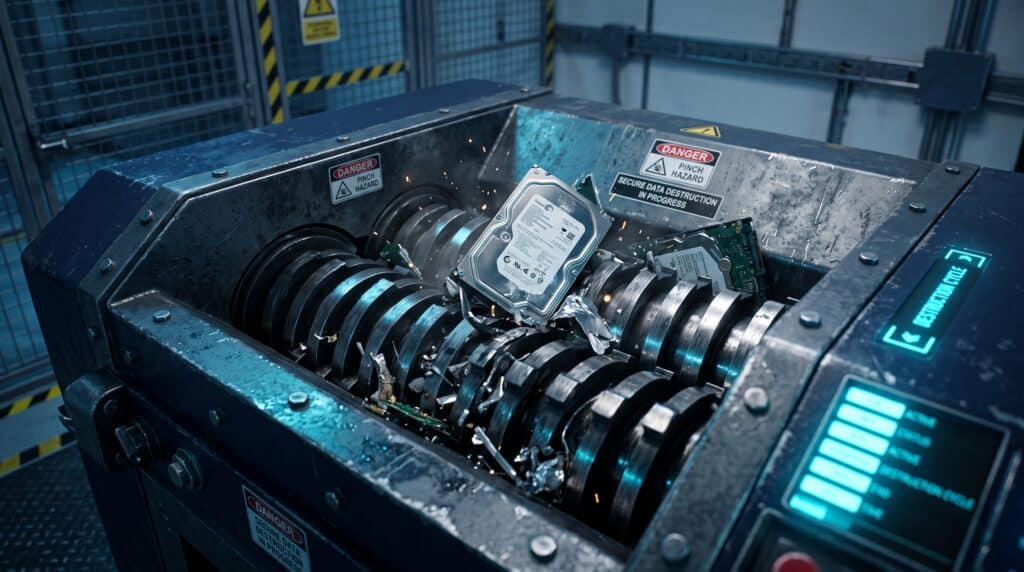
- Physical Shredding For obsolete hardware, malfunctioning drives, or organizations with strict internal security policies that prohibit the resale of storage media, physical destruction is the only acceptable method.
Industrial shredders are used to pulverize hard disk drives (HDDs), solid-state drives (SSDs), magnetic tapes, and USB arrays into small metal fragments. Because SSDs store data on dense microchips rather than magnetic platters, the shredding machinery must be calibrated to a highly specific micro-shred size (often 2mm or smaller) to ensure every individual memory chip is physically obliterated. Once a drive is shredded, data recovery is scientifically impossible.
Stage 3: Responsible E-Waste Recycling
The ITAD lifecycle is not just about data security; it is heavily focused on environmental stewardship. Electronic waste (e-waste) is the fastest-growing waste stream globally, and improper disposal carries severe environmental and financial consequences.
- Hazardous Material Mitigation Business-grade IT equipment contains a variety of hazardous materials, including lead, mercury, cadmium, and beryllium. When obsolete computers are illegally dumped in landfills, these toxic heavy metals eventually leach into the soil and groundwater. Modern ITAD providers operate under strict Zero-Landfill policies, ensuring that no raw electronic waste ever ends up in a municipal dump.
- The Circular Economy and Material Recovery Instead of discarding hardware, the physical remnants are processed to reclaim valuable resources. Shredded components are sorted using advanced magnetic, optical, and density separation techniques.
Precious metals like gold, silver, palladium, and copper are extracted and reintroduced into the global manufacturing supply chain. Plastics, aluminum, and steel are similarly processed and recycled. This closed-loop recycling process drastically reduces the need for destructive raw material mining and lowers the carbon footprint of future technology production. By partnering with a certified ITAD provider, your business actively contributes to corporate sustainability goals.
Stage 4: The Compliance Audit and Certification
The final stage of the ITAD lifecycle transitions the process from a physical operation into a legally binding administrative record. Without verifiable proof of destruction, your company remains legally liable for the data that was housed on the retired hardware.
The Certificate of Destruction (CoD) Upon completion of the wiping or shredding process, the ITAD provider issues a formal Certificate of Destruction. This is not a simple receipt; it is a legally defensible document. The CoD itemizes every individual serial number that was processed, the exact method of destruction used (e.g., NIST 800-88 Wipe or Physical Shredding), the date and time of the destruction, and the signature of the authorizing technician.
Regulatory Adherence In the event of a regulatory audit, the CoD serves as your proof of compliance. Different industries are governed by distinct data protection frameworks:
- Healthcare: The Health Insurance Portability and Accountability Act (HIPAA) mandates strict controls over electronic Protected Health Information (ePHI) during hardware disposal.
- Finance: The Payment Card Industry Data Security Standard (PCI-DSS) requires the secure destruction of any media containing cardholder data.
- General Business: Broad privacy laws, such as the General Data Protection Regulation (GDPR) in Europe and various state-level privacy acts in the US, enforce severe penalties for the exposure of consumer data.
Maintaining a centralized archive of your Certificates of Destruction protects your organization from devastating non-compliance fines and legal liability. It provides immediate answers when auditors or stakeholders ask how your company handles endpoint data lifecycles.
Integrating ITAD into Your Business Strategy
As Dymin celebrates our 25th anniversary this September, we reflect on how much enterprise technology has changed. The shift from on-premise servers to hybrid cloud environments has drastically accelerated the rate at which hardware is cycled out and replaced. Managing this constant rotation requires a proactive strategy.
Do not wait until the IT storage closet is overflowing to think about asset disposition. Integrate ITAD directly into your hardware procurement and lifecycle management policies. When a new laptop is deployed, the retirement and destruction of the old laptop should be automatically scheduled.
By treating hardware retirement with the same level of security and precision as network deployment, you close the final loop in your cybersecurity perimeter. Clear out the clutter, protect your intellectual property, and ensure your business remains compliant and secure for the future.